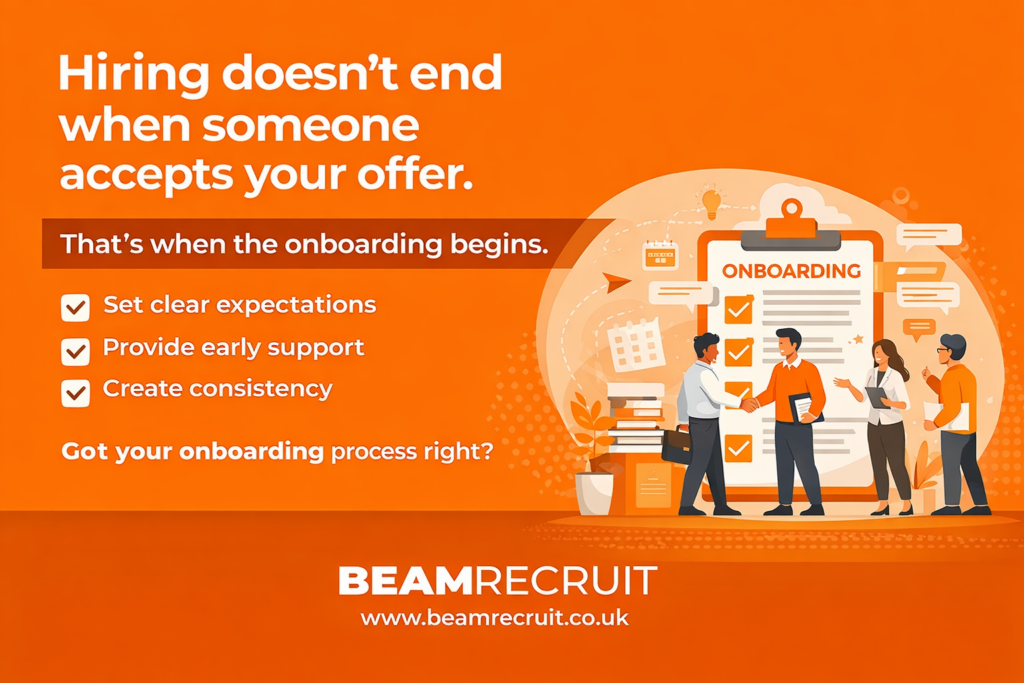
Across many SMEs, a lot of effort goes into hiring.
Time is spent defining the role.
Energy goes into interviews.
Decisions are carefully considered.
But then something interesting happens.
Once the offer is accepted the structure often disappears.
And that’s where one of the biggest risks in hiring now sits: onboarding.
The Hiring Process Doesn’t End at Offer Acceptance
If you think about it, onboarding is the point where expectation meets reality.
It’s where:
- The job description becomes a lived experience
- The culture you’ve described is tested
- The manager-employee relationship really begins
And if that experience doesn’t align with what was promised, problems start early.
Disengagement.
Underperformance.
Early exits.
Not because you hired the wrong person but because the transition into the business wasn’t managed properly.
Why This Stage Matters More Now
With changes to employment law, particularly around unfair dismissal, the margin for error is tightening.
Early employment decisions are likely to face greater scrutiny.
Which means:
- Poor onboarding can no longer be brushed off as “they just didn’t settle”
- Lack of clarity or support may become harder to defend
- Inconsistent processes increase both people risk and legal risk
If expectations haven’t been clearly set, supported, and documented from day one, it becomes much more difficult to justify decisions later.
Onboarding is no longer just a “nice to have”.
It’s part of your risk management.
What Good Onboarding Actually Looks Like
Strong onboarding doesn’t need to be complicated. But it does need to be intentional.
At its core, it should focus on three things:
1. Clarity
- What does success look like in the first 30, 60, 90 days?
- What are the priorities?
- How will performance be measured?
This links directly back to your job and person specification. If those are clear, onboarding becomes much easier to structure.
2. Consistency
- Do all new starters go through a similar process?
- Are managers aligned in how they support new hires?
- Is there a clear framework, not just ad hoc conversations?
Inconsistent onboarding leads to inconsistent outcomes.
3. Connection
- Does the individual feel part of the team?
- Do they understand the culture beyond what was said in the interview?
- Are relationships being built early?
People rarely leave roles purely because of the job. They leave because they don’t feel connected, supported, or clear on where they stand.
The Link to Retention
Most retention issues don’t start six or twelve months in.
They start in the first few weeks.
When:
- The role isn’t what was expected
- The support isn’t there
- The business feels different to how it was described
By the time you see the signs, the decision to leave has often already been made.
Good onboarding doesn’t just help someone “settle in”.
It significantly improves:
- Time to productivity
- Engagement
- Long-term retention
Bringing It All Together
If you look across the hiring journey:
- A clear job and person specification attracts the right people
- A structured interview process helps you assess them properly
- And onboarding determines whether that hire actually succeeds
Miss the final step, and everything that came before it is weakened.
Final Thought
As the employment landscape shifts, the businesses that will stand out are not the ones doing anything overly complex.
They’re the ones doing the fundamentals well, consistently.
Onboarding is one of those fundamentals.
And it may just be the stage that makes the biggest difference to:
- Retaining your people
- Protecting your business
- And turning good hiring decisions into successful long-term hires
If this has made you pause and think about your own onboarding, and you’d like to talk it through, just get in touch. We’re always happy to help.